
Platform Papers 2025 Year-in-Review
The state of platform competition research in 2025.
Platform Papers is a blog about platform competition and Big Tech. Prominent academics discuss their latest research. The blog is linked to platformpapers.com, a repository that collects and organizes academic research on platform competition.
By Joost Rietveld.
Initially it looked like 2025 would see a rare decline in the number of academic articles published on platform competition (as tracked by the Platform Papers References Dashboard). The number of newly added papers was down halfway through the year and I was fully ready to blame AI, platform fatigue, or my search algorithm missing some shift in author keywords. Turns out, I needn’t have woried...
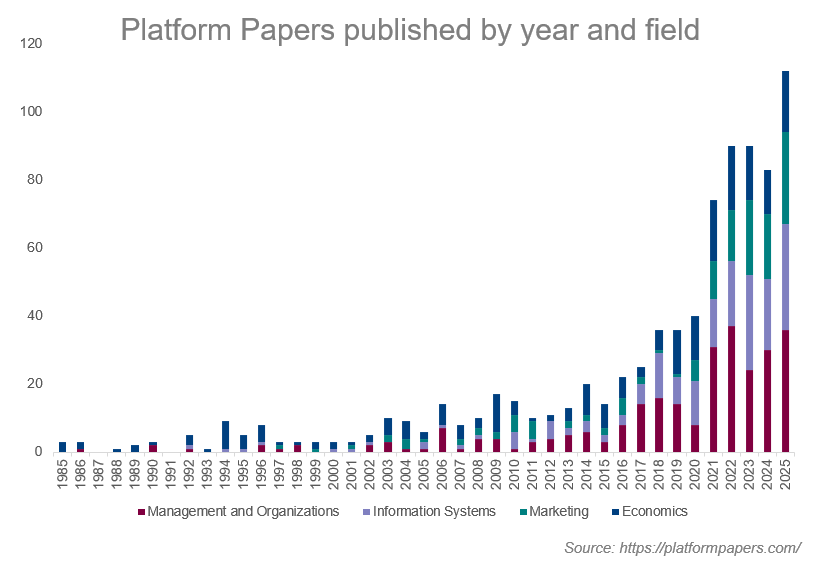
In 2025, 96 newly published academic articles on platform competition were added to the Platform Papers database (Platform Papers). After adding publication-date rollovers from last year, that brings the total number of Platform Papers published in 2025 to 112—up 35% from 2024; another record year! (Some recently published papers likely will rollover to 2026 as they transition from Online First to print publication.)
The distribution of published papers across disciplinary fields is as follows: Management and Organizations (32% of all 2025 Platform Papers), Information Systems (28%), Marketing (24%), and Economics (16%). Contrasted to prior years, this suggests that economics continues to lose prominence as the primary field for platform competition research, whereas marketing continues to gain prominence.
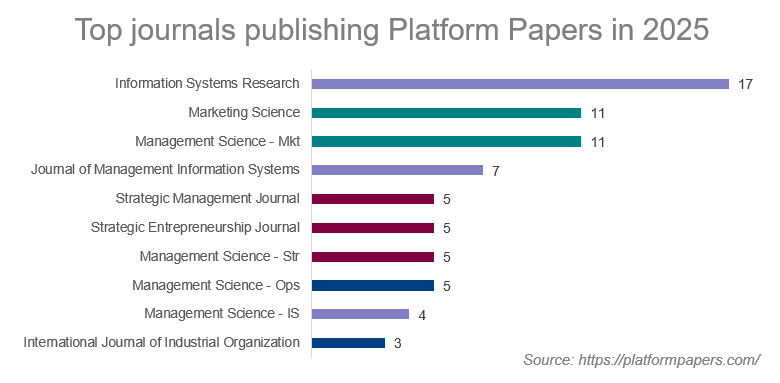
Management Science was the journal publishing most Platform Papers in 2025—25 newly published articles across the journal’s various editorial departments. This was followed by Information Systems Research (17 articles) and Marketing Science (11). The chart below lists the top 10 journals publishing platform competition research in 2025, breaking out the different Management Science departments as separate entries.
This was the first year a publication in the Academy of Management Annals was added to the Platform Papers database.
44% of all 2025 Platform Papers analyze large scale empirical data, 35% test an economic model, and the remaining 21% comprise a mix of qualitative and conceptual studies.
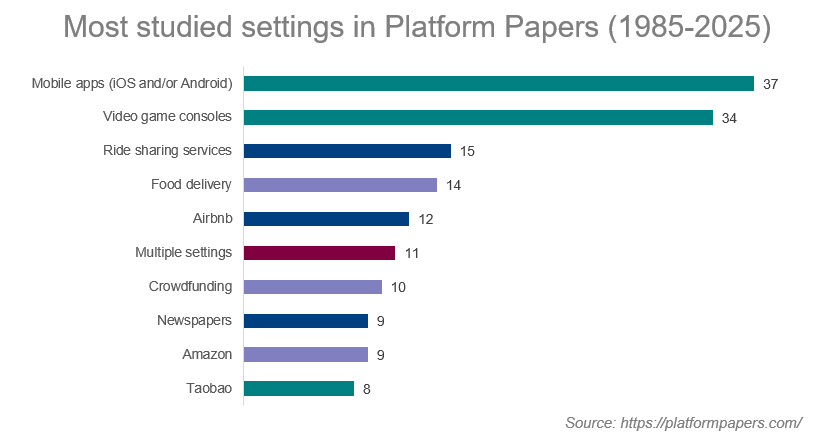
Last year, mobile app stores overtook video game consoles as the ‘canonical context’ in platform competition research for the first time. Research on food delivery platforms also is on the rise; it was the fourth most-studied setting—up from 7th place in 2024. Amazon, Taobao and other e-commerce platforms continue to gather attention. Online labor platforms also were frequently researched. Some first-time studied contexts in 2025 include board games, Chess.com, Open AI, Reddit, and Goodreads.
In terms of substance, at a high level, there is strong and increasing interest in heterogeneous platform effects (e.g., heterogeneous network effects, differences in pricing models, differences across platforms, etc.). 32% of all Platform Papers in 2025 were assigned this theme (papers can be assigned to more than one theme). Research on network effects, platform pricing, and winner-take-all dynamics remained popular overall at 26%, but this theme is losing ground compared to prior years. Research on orchestration and platform governance also remained popular at 25%. Papers covering platform scope, including horizontal expansion and competing with complementors saw steady coverage with 16% of all 2025 Platform Papers assigned to this theme.
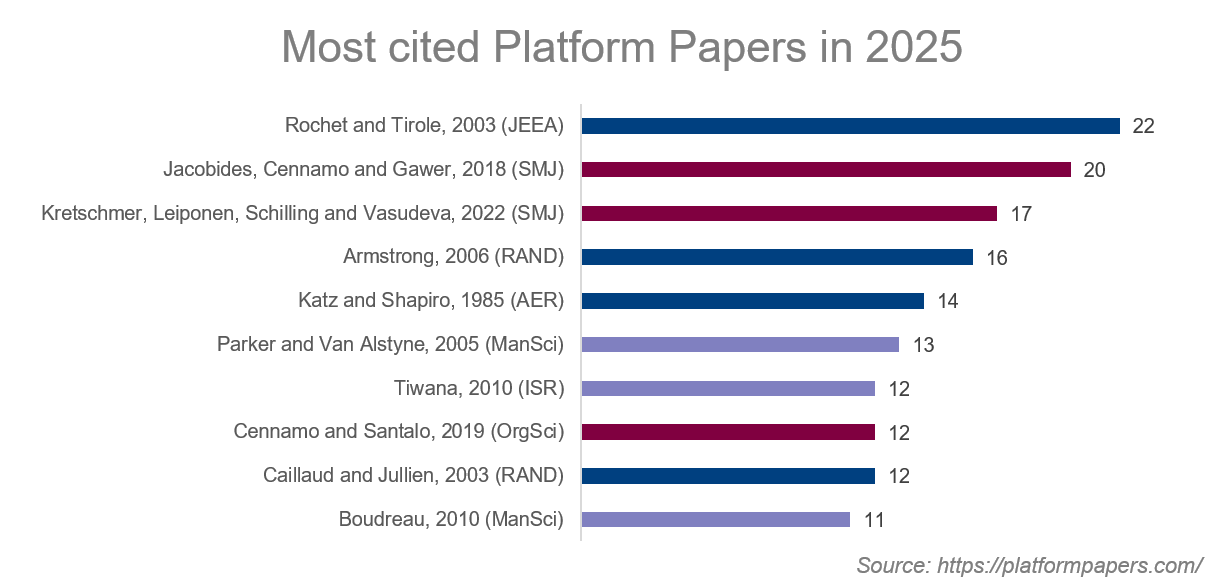
Last year I looked at the most-cited Platform Papers across two different time periods. This year flips the perspective ever-so slightly: What were the most-cited papers by Platform Papers published in 2025? The top 10 most-cited Platform Papers in 2025 exhibit a nice mix of ‘evergreens’ (such as Rochet and Tirole’s seminal 2003 paper in JEEA) and more recent publications (including the influential 2022 SMJ platforms special issue editorial by Kretschmer, Leiponen, Schilling and Vasudeva).
In 2025, Platform Papers covered such topics as the growing prevalence and importance of advertising in digital platforms; the impact of platform design on innovation in downstream complementor markets; the role of star complements in platform ecosystems (1, 2, 3); the challenges concerning various aspects of platform governance (1, 2); and, multiple facets of platforms that caught the attention of antitrust scholars and regulators (e.g., platform most-favored nation clauses, platforms strategically entering complementor markets, and how to think about market power in platform-mediated markets). Platform Papers also covered some of the myriad ways platforms are deployed in less obvious contexts, such as platform-cooperatives in the sharing economy and platforms for financial inclusion in developing countries.
Top 5 most-read Platform Paper blogs published in 2025
The Kill Zone (Massimo Motta and Sandro Shelegia)
Rethinking Market Power in the Digital Platform Era (Paul Belleflamme, Eric Toulemonde, and Martin Peitz)
Demand Spillovers in Digital Platforms (Manav Raj)
Making B2B Platforms Work (Virginia Springer, Krithika Randhawa, Marin Javonovic, Paavo Ritala, and Frank Piller)
The Price of Platform Participation (Kai Zhu, Qiaoni Shi, and Shrabastee Banerjee)
Collectively, these five blogs accumulated more than 10,000 reads on Substack!
Platform Papers now has more than 1,800 Substack subscribers (including a few paid ones—thank you!!), up from 1,300 in 2024. Subscribers come from 82 different countries and 41 U.S. states. I published 17 blogs in 2025. I added platform-related news updates in 2025, and I partnered with Platform Leaders to shortlist academic articles for the Platform Leaders Academic Prize (won by Manav Raj).
I presented Platform Papers in Europe, South-East Asia and the US, including at the European Digital Platform Research Network (EU-DPRN) conference in Madrid.
There are many topics I hope to cover in 2026 (e.g., the shift from adding users to user engagement as a relevant platform metric, the importance of interoperability in platform competition, the effect of platforms on traditional industry structure, etc.). For now, though, I warmly thank all authors who have contributed to Platform Papers, and, in so doing, have helped bridge academic research to interested audiences.
If you enjoy this content, please share, subscribe, re-stack, etc. If you have any feedback or suggestions for improvement, feel free to reach out to me.
Happy Holidays!
Platform Papers is published, curated and maintained by Joost Rietveld.