
Platform Papers is a blog about platform competition and Big Tech. Prominent academics discuss their latest research. The blog is linked to platformpapers.com, a repository that collects and organizes academic research on platform competition.
By Kai Zhu, Qiaoni Shi, and Shrabastee Banerjee.
Digital platforms increasingly ask creators to pay to reach audiences—think fees to list, promote, or boost content. Those fees raise revenue, but they can also change who participates, which products get exposure, and how satisfied users feel. We study these dynamics in a recent paper published in Management Science using a large policy change on Goodreads, the world’s biggest book community with 125+ million registered users.
In January 2018, Goodreads began charging a fixed entry fee (USD $119) for authors and publishers to run “Giveaways,” a program that sends free copies to readers to spark reviews and discovery. The change was announced on November 28, 2017 and took effect on January 9, 2018, creating a clean before/after comparison. We analyze comprehensive data on Giveaways campaigns, book metadata, and user reviews from 2016–2020.
What changed on the supply side?
Participation fell and the market consolidated
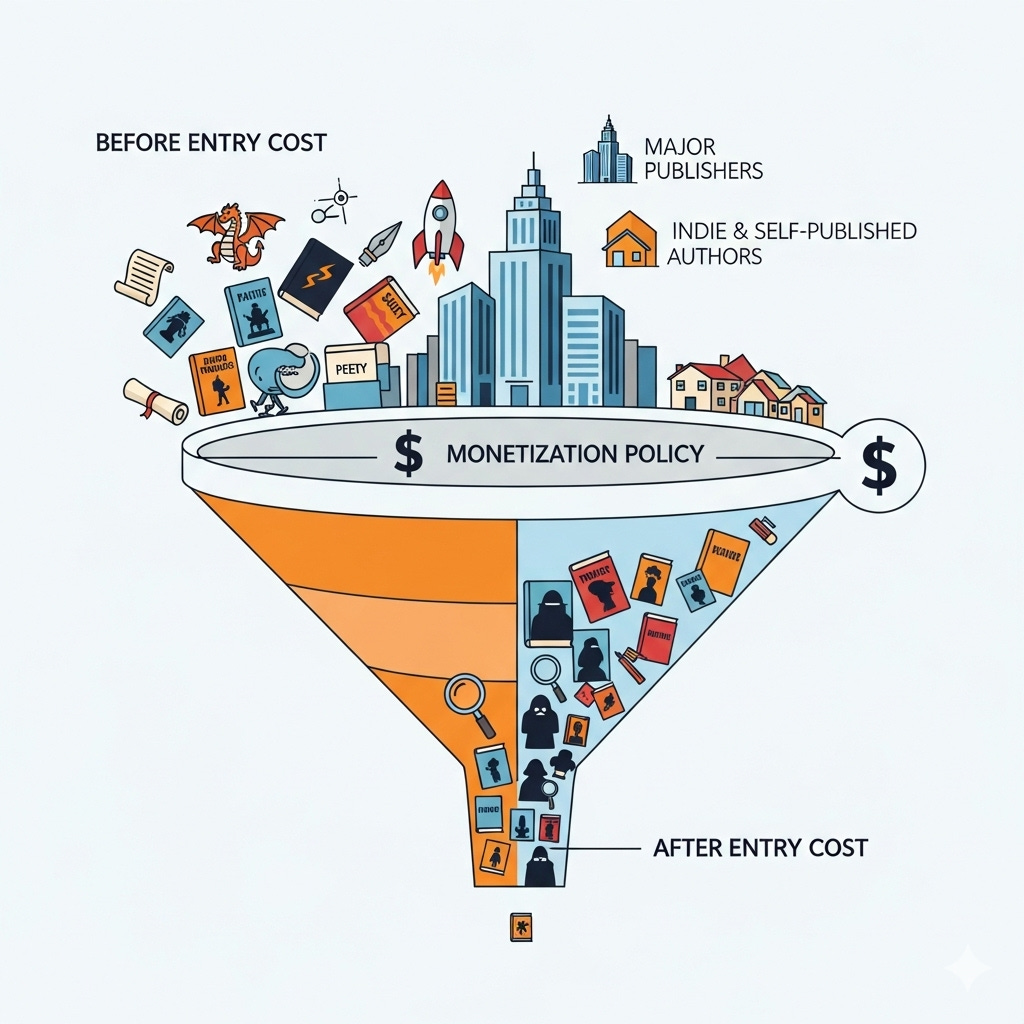
After the fee, overall participation in Giveaways dropped, and the composition shifted toward large, established publishers. The share of books from the “Big 5” publishers more than doubled—from 12% to 30%—while small indie and self-publishing participants pulled back sharply. Measured by the Herfindahl–Hirschman Index (HHI), concentration rose substantially: average HHI increased by 200% after monetization.
The participants who stayed were, on average, more established: authors with more ratings and reviews, larger Goodreads networks, and more prior experience running Giveaways. This is exactly what you would expect when a fixed cost screens out newcomers.
Variety narrowed
Diversity of promoted books (by genre) declined after the entry fee. Using an entropy-based index, we observe a clear, statistically significant drop in genre diversity post-monetization. Popular genres (thriller, mystery, historical fiction) gained share, while niche areas (science, psychology, poetry) lost ground. In relative terms, niche genres’ shares fell by as much as 26% from their own baselines; popular genres rose by about 11%.
What changed on the demand side?
More engagement—but lower satisfaction
For books that ran Giveaways, the promotion “worked harder” after monetization: titles received more reviews per month (about +14.5), yet their average star ratings dipped by about 0.05–0.08 stars relative to the pre-monetization era. In short, adoption rose, but satisfaction slipped.
Why? Our text analysis of reviews points to mismatches between readers and books. Using a transformer-based text classifier trained on human-labeled data, we detect a higher share of negative reviews driven by “fit” problems (e.g., a romance fan wins a literary biography), rather than quality complaints. To quote a reviewer from our dataset: “I was sure this would be a 5 star but it just wasn’t for me.” Monetization appears to have altered both the mix of books and the composition of participants in ways that increase the odds of bad matches—amplifying the well-known “Groupon effect” where promotions boost volume but can depress ratings.
We also observe downstream engagement effects consistent with less enthusiastic reader response to the program overall (e.g., a large decline in user requests to enter Giveaways), reinforcing the idea that participation fees reshape both sides of the market.
About the research: We study Goodreads’ 2018 introduction of a $119 fixed cost to run book “Giveaways.” Using comprehensive data from 2016–2020 (covering 120k+ unique books), we analyze supply participation, genre diversity, and demand responses. Post-monetization, the Big 5’s share of promoted books more than doubled (12%→30%), and concentration rose (HHI 0.01→0.03). Genre diversity fell: popular genres gained, niche genres’ shares dropped (up to –26% relative to their baselines). On the demand side, Giveaways generated more reviews (+14.5 per month) but lower average ratings (–0.05 stars), with review text indicating increased reader–book mismatches as a mechanism.
Why this matters beyond books
Although our setting is book promotion, the mechanisms are general to many creator and app ecosystems: when a platform adds a fixed entry fee, it disproportionately deters smaller players, increases concentration, and can reduce product variety, especially in cultural markets where tastes are diverse and matching is critical. Those shifts can yield more “wrong-reader” (or wrong-user) matches, where exposure rises but satisfaction falls. For managers, this presents a trade-off between short-term revenue and long-term ecosystem health.
What should platforms and policymakers do?
Design with distribution in mind. If you need to monetize participation, consider tiered pricing (e.g., lower fees for early-stage creators), vouchers or subsidies for resource-constrained segments, or fee holidays for niche categories. These tools can preserve diversity without abandoning revenue.
Invest in matching quality. Better targeting and interest-based placement can reduce misfits, sustaining ratings even as volume grows. Our results suggest that the painpoint is not quality per se, but the match between reader and book, an insight that extends to apps, videos, music, and games.
Watch the ecosystem metrics. Track concentration, variety, and satisfaction together. Monetization that looks good on revenue can quietly narrow the funnel and erode user interest. In our setting, while Goodreads likely raised several million dollars from fees in the first two years, it did so alongside higher market concentration and lower average ratings.
The bigger picture
Two-sided markets are powered by cross-side network effects: more creators attract more users, and vice versa. Entry costs can curb spam and low-quality listings, but in markets where variety is the value proposition, fixed fees risk filtering out precisely the suppliers who keep things vibrant. The result is a platform that is more monetized, but less generous in discovery. Our study shows how these trade-offs play out in practice and offers a framework for designing monetization that sustains both revenue and relevance.
This post is based on research published in Management Science and is included in the Platform Papers references dashboard:
Zhu, K., Shi, Q., & Banerjee, S. (2025). Monetizing platforms: An empirical analysis of supply and demand responses to entry costs in two-sided markets. Management Science.
Manav Raj wins Platform Leaders Academic Prize for Relevance
Each year, Platform Leaders awards a prize to an academic paper that demonstrates exceptional relevance and practical applications to the business world. This year’s finalists have been selected in partnership with platformpapers.com.
The winner is selected by a business jury. Platform Leaders invites the winner to present the paper’s key findings at its annual conference and also commisions an animated video abstract highlighting the research’s key ideas (see below).
Congratulations to Manav Raj and his paper More is (Sometimes) Merrier: Heterogeneity in Demand Spillovers and Competition on a Digital Platform for winning this year’s Academic Prize for Relevance! Manav recently documented the key findings from his research in a blogpost for Platform Papers (link to post).
Congrats also to the other finalists Hyuck David Chung, Yue Maggie Zhou, and Christine Choi and Tobias Kircher and Jens Foerderer.
Last year’s acacdemic prize was awarded to Joe Ploog and Joost Rietveld for their paper Rolling the dice: Resolving demand uncertainty in markets with partial network effects.
Platform Updates
Meta does not hold a monopoly, US judge rules (1) (2): Meta defeated a major challenge to its business when a US judge ruled that the company does not hold a monopoly in social networking. Key in reaching the decision was a piece of analysis conducted by Meta’s expert John List showing that if users were paid not to user Facebook/Instagram/Whatsapp, they shifted their time to YouTube, TikTok or Snap, which the FTC had excluded from its market definition.
Epic unlocks Android’s future—with Google’s blessing (1) (2): In a landmark settlement, Google agrees to open Play Store doors to rival app stores, slash developer fees, and simplify payments worldwide—if the court approves. The deal could reset competition, lower costs, and rewrite rules for app marketplaces.
EU reignites clash with Google over news rankings: Brussels readies a fresh probe into Alphabet over news ranking and sponsored content, coming weeks after a €2.95bn fine on Google. The move may risk deepening transatlantic tensions as Washington threatens retaliatory tariffs over Europe’s digital taxes.
Google offers EU AdTech olive branch—no breakup: Facing record fines of $3.4bn, Google proposes new tools and flexibility for publishers and advertisers to dodge a forced AdTech divestment. The EU weighs whether the concessions are enough to restore competition—or if a historic breakup still looms.
Game Pass, or game change? Microsoft restructures its $30 Game Pass Ultimate tier around actual player usage by segmenting heavy and casual users and testing ad-supported plans. Xbox aims to fix the mismatch between costly infrastructure and uneven demand, pivoting toward a service-driven future.
Players build, publishers profit: New study shows that games with official user-generated content or mod support see up to 31% more revenue and over double the sales of downloadable content. This stems from higher player retention and engagement across PC, consoles, and VR, enabled by player creation.
Microsoft plots OpenAI-less vision: AI chief Mustafa Suleyman unveils a strategy for self-sufficient, human-aligned systems as Microsoft builds its MAI Superintelligence Team. The firm pivots from software/cloud roots to AI-first infrastructure, powered by its planet-scale cloud, AI factory, and copilot functions.
Netflix eyes Warner Bros.’ streaming and studio assets: Netflix’s bid for HBO and Warner Bros. aims to expand content library and subscriber base. However, the proposed deal has sparked debate over potential impacts on industry competition and content diversity as its subscriber base already exceeds 300M.
Platform Papers is published, curated and maintained by Joost Rietveld.