
When Platform Antitrust Chills Entrepreneurship
Evidence from China
Platform Papers is a blog about platform competition and Big Tech. Prominent academics discuss their latest research. The blog is linked to platformpapers.com, a repository that collects and organizes academic research on platform competition.
By Ke Rong, Daniel Sokol, Di Zhou, and Feng Zhu.
Across jurisdictions, regulators have turned to antitrust enforcement and platform regulation in an effort to curb the power of large digital platforms and promote competition. A central promise of these interventions is that by restraining large incumbents, regulators can create space for new firms, stimulate entrepreneurial entry, and ultimately enhance innovation.
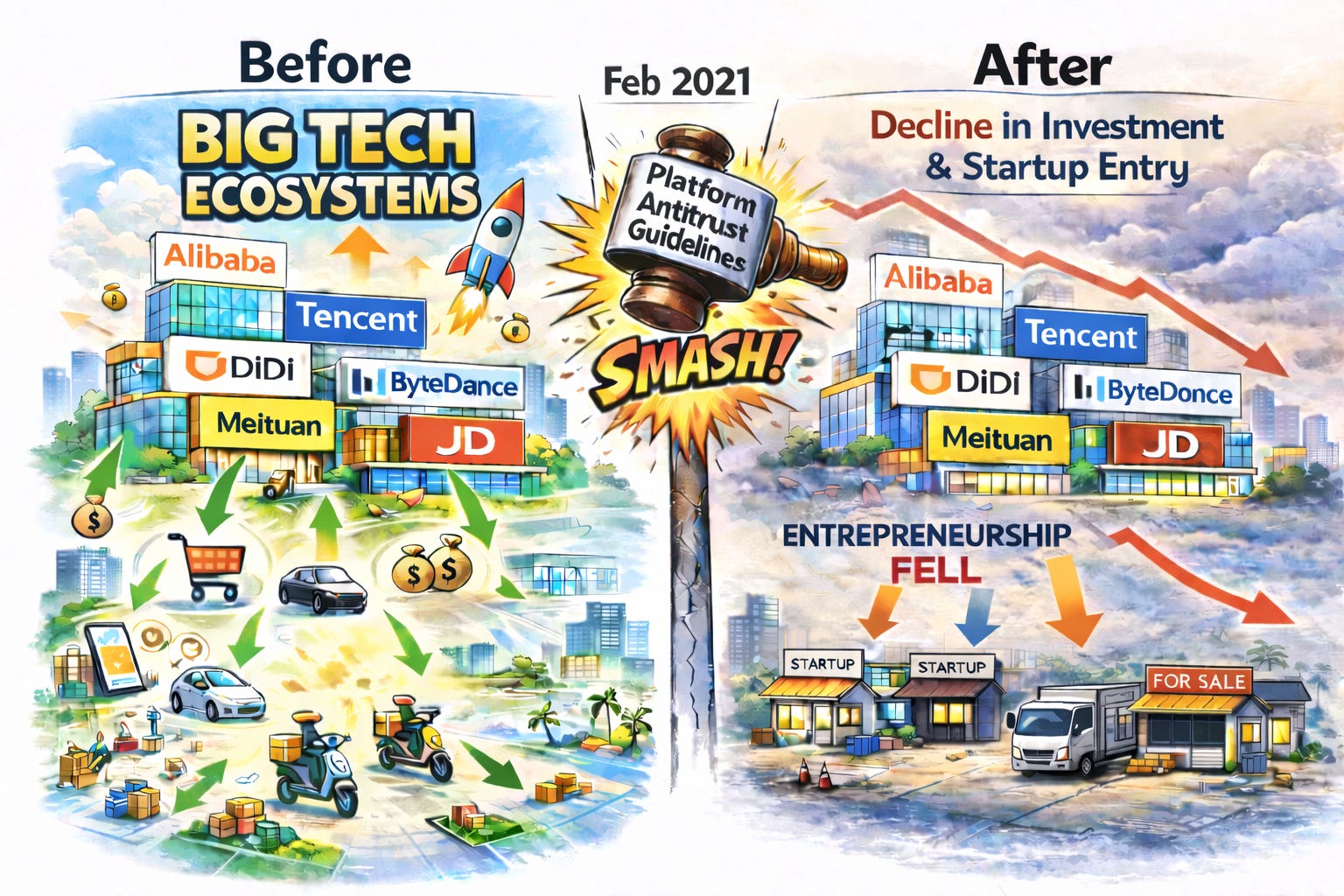
China’s platform antitrust campaign offers an unusually clear opportunity to test this promise. On February 7, 2021, China formally implemented the Anti-Monopoly Guidelines for the Platform Economy (Platform Guidelines). The policy marked a decisive shift in its regulatory stance and was followed by swift and highly visible enforcement actions against major digital platforms. Because the timing and scope of the intervention were explicit and economy wide, the Platform Guidelines function as a sharp regulatory shock.
In our forthcoming paper in Management Science, we ask a simple but fundamental question: When antitrust regulation constrains large platforms, does entrepreneurship increase in the markets where those platforms are most active?
“If platform regulation changes expectations about future growth, profitability, or permissible conduct, its effects are likely to spill over to startups and investors operating nearby.”
The answer is surprising. In industries closely connected to regulated platforms, entrepreneurship in terms of investment and entry declines rather than expands.
A Broad Shock to the Platform Ecosystem
The Platform Guidelines targeted conduct that had long been central to platform expansion, including exclusive dealing, discriminatory pricing, self-preferencing, and aggressive acquisition and investment strategies. Enforcement focused on a set of large digital firms that together form the backbone of China’s platform economy, including Alibaba, Tencent, ByteDance, DiDi, Meituan, and JD.
These firms operate through complex ecosystems that span multiple product and service markets. As a result, the reach of the policy extended well beyond the platforms themselves. Numerous related industries depend on platform infrastructure, platform investment, or platform enabled demand.
This ecosystem perspective is crucial. If platform regulation changes expectations about future growth, profitability, or permissible conduct, its effects are likely to spill over to startups and investors operating nearby.
Why Entrepreneurship Declined
Our main finding is straightforward. After the introduction of the Platform Guidelines, entrepreneurship declined in industries that were most affected by the regulated platforms prior to the policy. Venture investment activity fell sharply, and fewer new firms were created. The magnitude of the decline is economically meaningful and persistent.
This pattern runs counter to the common intuition that restraining large platforms frees up space for new entrants. Instead, the markets most closely connected to platforms appear to become less hospitable to entrepreneurial activity.
“Affected industries experienced a 22.66% decline in monthly investments and a 17.37% drop in new firm entry relative to controls, driven primarily by reduced early-stage financing.”
At first glance, this result may seem puzzling. If platforms face tighter constraints, startups, should face less competition. The key to understanding this counterintuitive result lies in expectations and uncertainty.
Platform antitrust does not merely restrict incumbent behavior. It also signals that the regulatory environment surrounding platform-related business models is changing. For entrepreneurs and investors, this raises difficult questions. For example, which strategies will remain viable as firms scale? Which forms of integration or monetization will be viewed unfavorably by regulators? How stable are the rules governing platform mediated markets? When these questions lack clear answers, early-stage investment activity is often the first to respond and does so negatively.
Role of Early-stage Capital
A key mechanism behind our results is a contraction in early-stage financing. After the policy shock, seed and early-round investments decline disproportionately in industries affected by the platform giants.
This matters because early-stage capital is the lifeblood of entrepreneurship. It finances experimentation, supports market entry, and allows founders to test ideas before outcomes are certain. When this funding becomes scarcer, fewer startups are launched, even if long run opportunities remain. Importantly, the decline does not appear to be driven by investors simply relocating capital abroad. Instead, investors become more cautious within the affected markets themselves, consistent with heightened perceived policy risk.
How Entrepreneurs Adapt
Entrepreneurs also respond strategically to the new regulatory environment. After platform antitrust takes effect, new startups in affected industries are less likely to resemble the business models of the large platforms themselves. Rather than building close substitutes or complements, entrants appear to differentiate away from platform-like strategies. This shift suggests that regulation shapes not only how much entrepreneurship occurs, but also what kind of entrepreneurship emerges. Founders may avoid business models that could draw future scrutiny, even if those models were previously attractive or scalable.
About the research: We study the impact of China’s 2021 Anti-Monopoly Guidelines for the Platform Economy on entrepreneurship in tech-related industries. Using startup entry and VC and CVC investment data across 168 industries from 2020 to 2022 and a difference-in-differences design, we compare 41 industries with significant pre-policy exposure to major platforms including Alibaba, Tencent, ByteDance, JD, Meituan, and DiDi to 127 unaffected industries. After the regulation, affected industries experienced a 22.66% decline in monthly investments and a 17.37% drop in new firm entry relative to controls, driven primarily by reduced early-stage financing. The findings suggest a regulatory chilling effect, with antitrust intervention dampening rather than stimulating entrepreneurial activity.
Implications
The results of this study have important implications for antitrust platform regulation.
First, our findings suggest that platform antitrust regulation does not necessarily foster greater competition in the short to medium run. In the period we study, China’s Platform Guidelines made the investment environment in affected industries less attractive for startups, rather than more conducive to entry. This highlights the need for policymakers to carefully evaluate whether regulatory interventions aimed at constraining large platforms achieve their intended competitive objectives, particularly when entrepreneurship is a key policy goal.
Second, the evidence underscores the central role of regulatory uncertainty in shaping entrepreneurial and investment decisions for management. The introduction of the Platform Guidelines substantially altered expectations among startups and investors regarding the risks associated with operating in platform related sectors. Increased uncertainty about regulatory boundaries and future enforcement appears to have undermined confidence, especially in contexts where business models rely heavily on platform participation or platform-enabled interactions. Such expectation shifts can materially affect entrepreneurial activity even in the absence of direct regulatory targeting of startups themselves.
Third, these implications are not unique to the Chinese context. Although China’s institutional environment is characterized by a stronger role of the government in economic regulation and by faster and more stringent policy implementation, similar unintended effects have been documented in other regulatory domains and jurisdictions, including data privacy regulations such as GDPR and CCPA. In this sense, the Chinese experience provides a particularly clear illustration of how platform regulation can reshape entrepreneurial expectations more broadly.
Taken together, these implications suggest that platform antitrust regulation may have wider ecosystem level consequences that extend beyond incumbent platforms. For policymakers, the findings highlight the importance of anticipating how regulatory interventions affect startup and investor expectations, especially in environments where policy changes are implemented rapidly and with limited transitional periods. For entrepreneurs and investors, the results emphasize that regulatory uncertainty has become an integral component of the operating environment in platform related industries, with meaningful consequences for entry and investment decisions.
This post is based on research published in Management Science and is included in the Platform Papers references dashboard:
Rong, K., Sokol, D. D., Zhou, D., & Zhu, F. (2025). Antitrust platform regulation and entrepreneurship: Evidence from China. Management Science.
Platform Updates
Beijing blocks Meta’s $2bn Manus AI buyout (📑): Chinese regulators have vetoed Meta’s $2 billion buyout of Manus, a startup specializing in autonomous AI agents, citing stringent tech export controls. The forced reversal may stall Meta’s push to embed task-executing AI across its ecosystem, exposing the geopolitical risks of cross-border M&A.
Beijing mandates a new labor protection plan for the gig economy (📑): China’s new labor plan aims to protect 200 million gig workers by calling for fair wages, a stronger social security system, and enhanced labor protections. The mandate also urges platforms to increase transparency in algorithmic pricing and to reform high-commission architectures.
EU targets Meta’s frictionless onboarding over underage access (📑): A preliminary EU Digital Services Act (DSA) ruling accuses Meta of failing to gatekeep under-13s, threatening its core acquisition funnel. To reduce this friction, Meta is advocating an industry-wide age verification system, while the EU is pushing for a centralized EU digital ID system.
Uber accelerates super-app ambitions via Expedia integration (📑): By cross-listing Expedia’s hotel bookings and Uber’s rides across both apps, the companies are merging two massive multi-sided marketplaces. This strategic bundling and globalized Uber One membership may deepen user lock-in across the end-to-end travel journey.
Spotify flexes pricing power as multi-format bundling boosts margins (📑): Adding 3 million subscribers despite a recent US price hike signals strong platform lock-in. As revenue growth outpaced costs across music, audiobooks, and video podcasts, Spotify achieved 33% gross margins, largely driven by its growing premium subscription base.
OpenAI embraces multi-homing as Microsoft relaxes clause (📑): OpenAI secured rights to distribute models across rival clouds, neutralizing Anthropic’s multi-platform advantage. In exchange, Microsoft permanently retains the right to use OpenAI’s tech, killing the rule that revoked access once artificial general intelligence is reached.
Microsoft unbundles Call of Duty as cross-subsidization backfires (1) (2) (3) (📑): While cutting the price of its top-tier Game Pass subscription to halt user churn, Xbox is removing CoD as a day-one launch title. The retreat suggests that forcefully bundling misaligned user cohorts may fracture platform ecosystems.
GameStop launches $55.5bn hostile bid for eBay (📑,🔒): GameStop made a $55.5 billion unsolicited offer for the e-commerce giant, aiming to merge its physical storefronts with eBay’s digital marketplace. By transforming 1,600 retail locations into authentication and fulfillment hubs, GameStop hopes to strengthen eBay’s platform ecosystem.
Platform Papers is published, curated and maintained by Joost Rietveld.