
The Complementor’s Dilemma
How can challengers grow inside platform ecosystems dominated by big-tech firms?
Platform Papers is a blog about platform competition and Big Tech. Prominent academics discuss their latest research. The blog is linked to platformpapers.com, a repository that collects and organizes academic research on platform competition.
By Shiyuan (Eric) Liu, Jochem Hummel, Ola Henfridsson, Joe Nandhakumar.
Digital markets do not just produce dominant platforms, such as Apple iOS, Amazon, Google Android, they also produce the firms that might challenge them. But those challengers rarely show up as full-fledged rivals. More often, they begin as complementors: companies that grow on top of powerful platforms, plug into their interfaces, and tap into their user bases. For example, there are many complementary applications (e.g., Google Maps, Spotify, WhatsApp) that convince users to buy an iPhone. At first, that arrangement looks like a fruitful scenario for everybody. It makes innovation cheaper, scaling faster, and market entry less risky. But it also creates a trap. The more successful the complementor becomes, the more likely the dominant platform is to see it not as a useful partner, but as an emerging threat.

The Complementor’s Dilemma
That growth problem facing complementors is at the heart of our research. We call it the complementor’s dilemma: should a complementor pursue growth, even if doing so risks losing the support of the very platforms it depends on? Or should it stay in the platform’s good graces and settle for a smaller future?
Our paper studies that dilemma through the rise of Douyin in China, internationally known as TikTok. From its launch in 2016 to September 2018, Douyin grew from 0.75 million to 208.28 million users while moving from peripheral complementor to focal platform in China’s social media ecosystem.
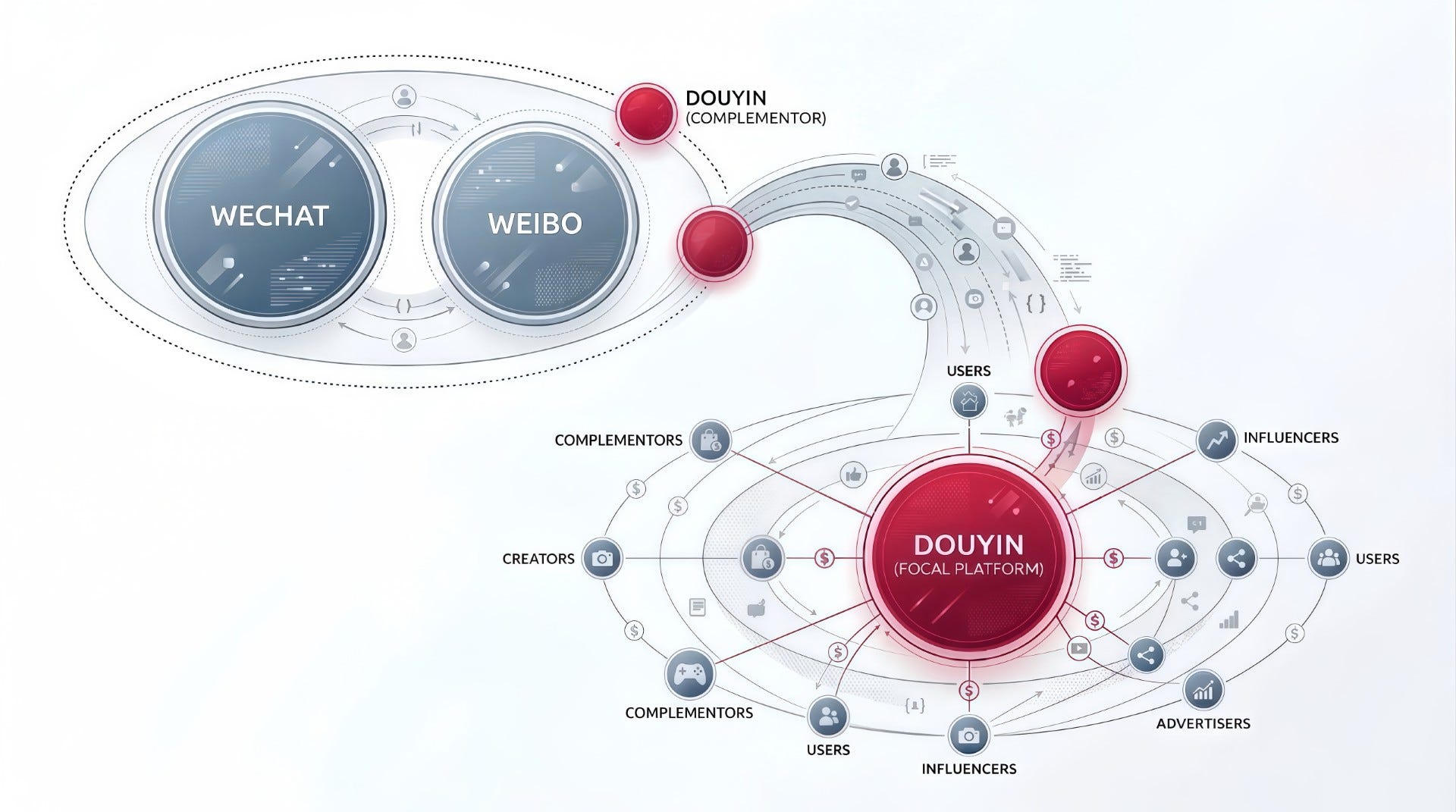
What makes the dilemma so difficult is that there is rarely a clean break. A complementor cannot simply walk away from an incumbent platform in an instant. It has to grow while still relying on the incumbent’s interfaces, user flows, and distribution channels. In Douyin’s case, more than 56% of users initially downloaded the app because friends shared its content and promoted it on existing social media platform giants such as WeChat and Weibo. Those linkages gave Douyin reach. But they also limited how far it could push its own growth before support turned into resistance.
Navigating the Complementor’s Dilemma
The key to understanding how to navigate the complementor’s dilemma is coupling. In platform ecosystems, firms are tied together socially and technically: through product positioning, overlapping users, and interoperability. So, the real strategic question is not simply whether to cooperate or compete. It is how tightly to couple yourself to the platforms you depend on, when to loosen those ties, and when to build the technical and user-side foundations for independence.
Douyin’s first move was restraint. Early on, it stayed tightly coupled to WeChat and Weibo. It improved the product, strengthened API linkages, and benefited from cross-platform sharing, but stopped short of turning itself into a full social community. That caution mattered. At that point, Douyin depended more on the incumbents than they did on Douyin. It had to resist the temptation to move too quickly, because a more aggressive growth push would have triggered retaliation from WeChat and Weibo.
The next move was more subtle. When WeChat lost its interest in short-form video, Douyin saw an opening because it knew WeChat would not see its growth as a threat. Therefore, it began targeting the users of the other incumbent: Weibo, more directly while deepening interfaces with WeChat. In other words, it moved toward selective coupling: loosening one dependency while leaning on another. That is an important lesson. Ecosystems are rarely all-or-nothing. Growth often depends on knowing where to stay plugged in and where to start pulling away.
Then the balance shifted again. As short-form video and algorithmic recommendation became more central to how users interacted online, Douyin had more room to act like a rival. It broadened user acquisition, imitated features associated with WeChat and Weibo, and connected to a wider set of actors across the ecosystem. This was competitive coupling: still tied to the incumbents, but no longer content to remain in the role as complementor. At that point, cooperation and competition blurred together.
By 2018, Douyin was able to make the final leap. Even after WeChat and Weibo blocked video sharing and intensified competitive pressure, Douyin had already built enough momentum to keep growing. It launched new social features, offered more monetization tools to users, and opened SDKs and APIs that let other firms build on top of Douyin. At that point, the former complementor was no longer just consuming ecosystem resources, it was starting to supply them. This was loose coupling: no longer dependent on incumbent platforms for its technical functioning or future growth. Douyin had become a focal platform in its own right.
About the research: Using an in-depth embedded case study of Douyin’s rise in China’s social networking ecosystem, we analyzed how a complementor can evolve into a dominant platform under the shadow of incumbent platforms. We combined quantitative and qualitative archival data from 2013–2020, including panel data on 40 short-form video actors, company archives, 75 interviews, 31 public speeches, and 1,220 published articles and reports. We traced Douyin’s growth from 0.75 million to 208.28 million users between 2016 and 2018 and identified a recurring complementor’s dilemma: grow and risk losing incumbent platform support, or preserve support and constrain growth. We identified two mechanisms through which firms navigate this dilemma, user scoping and product interfacing, and showed how shifts in coupling with focal actors shape the path from complementor to focal platform.
Take-aways for Managers
Manage coupling deliberately. User overlap and interoperability can accelerate platform growth, but they also reveal your vulnerabilities. Growth depends on knowing when to lean in, when to hold back, and when to stop treating platform access as a permanent home.
Read the ecosystem, not just your dashboard. Douyin’s moves worked partly because the environment was shifting: WeChat’s priorities changed, short-form video demand surged, and the algorithmic architecture became more favorable. Timing mattered as much as ambition.
Prepare for partners to become rivals. Successful complementors often end up competing with the very firms that helped them scale. Managers on both sides should plan for that shift early, including the possibility of blocking, imitation, or exclusion.
Build independence before confronting incumbents. The focal platform usually has the upper hand. Douyin could withstand isolation only after it had its own user base, monetization logic, social features, and complementors. Move too early, and the fight may be over before it begins.
There is a broader policy lesson, too. If government regulators and industry associations care about contestability in platform markets, they should not only ask whether dominant firms face rivals today. They should also ask whether complementors have a fair chance to become rivals tomorrow. The crucial bottleneck may lie at the transition point: the moment a complementor becomes threatening enough to trigger blocking, exclusion, imitation, or isolation. A market can look open to innovation on the surface while difficult to contest in practice.
We do not claim that every complementor can become a platform. In fact, our research suggests the opposite: this transition is rare and repeatedly interrupted by new dilemmas. Is helps explain why so few complementors ever become focal actors, and why platform ecosystems so often settle into mono- or oligopolistic structures.
Still, Douyin’s story shows that platform power is not fully fixed and can be challenged. But the challenge usually starts from within: with a complementor that knows when to stay coupled, when to decouple, and when to turn into a platform of its own.
This blog is based on research published in MIS Quarterly and is included in the Platform Papers references dashboard:
Liu, S., Henfridsson, O., Hummel, J. T., & Nandhakumar, J. (2025). The complementor’s dilemma: navigating growth ambitions and the dependency on focal actors in platform ecosystems. MIS quarterly, 49(3), 1123-1152.
Platform Updates
“We Must Act Now” - Economists sound the alarm over AI (📑): Nearly 200 economists—including 15 Nobel laureates—warn AI could disrupt the economy faster than the Industrial Revolution (1). The letter urges policymakers to build guardrails steering AI to complement humans, though it falls short of specific proposals (2).
Apple sues OpenAI for stealing iPhone secrets (📑): Apple accuses OpenAI hardware chief Tang Tan, a 24-year Apple veteran, of directing ex-colleagues to take out components and confidential files. The timing is no accident as OpenAI is reportedly building an AI phone that replaces apps with agents, challenging the heart of Apple’s hardware business.
Nadella tells AI rivals to stop scaring workers (🔈): Microsoft’s CEO publicly criticized OpenAI and Anthropic for predicting mass job losses, warning that society won’t accept an AI future that wipes out entire industries. The critique is also self-serving—still lacking a top AI model of its own, Microsoft profits most if no single AI giant wins.
Xbox scales back after Game Pass bet disappoints (📑): Microsoft will cut 3,200 gaming jobs and let go of five studios, including Double Fine and Ninja Theory, after its subscription strategy fell flat. Despite nearly $100 billion in acquisitions, revenue declined, pushing new CEO Asha Sharma to refocus on core franchises like Halo.
Sony kills the PlayStation disc (📑): From January 2028, all new PlayStation games will be digital-only, ending the disc era that defined the console since the 1990s. The shift hands Sony full control of distribution—no used-game resales, no rival retailers, every purchase locked inside the PlayStation Store’s commission walls.
BBC and Channel 4 plot a British Netflix rival (📑): BBC chief Matt Brittin revealed merger talks to fold Channel 4 into BBC’s iPlayer, calling for a British “sovereign platform” as young viewers defect to US streamers. Without scale, he warns that a few US and Chinese tech giants will dominate content creation and distribution.
Data regulation and digital product passports (📑): Peter Evans maps the data-sharing framework from a recent Platform Papers post onto the EU’s digital product passports for phones—data platforms coordinating the $70bn trade-in and resale market.
Belleflamme unpacks how platforms go bad (📑): Platform economist maps three routes to value destruction: squeezing users as early generosity fades—the classic enshittification (1); drifting from the original mission as platforms scale (2); and pushing costs onto non-users, from hooked teens to squeezed gig workers (3).
Platform Papers is published, curated and maintained by Joost Rietveld.