
Regulating Data on Digital Platforms
When it comes to innovation and welfare, sharing beats siloing.
Platform Papers is a blog about platform competition and Big Tech. Prominent academics discuss their latest research. The blog is linked to platformpapers.com, a repository that collects and organizes academic research on platform competition.
By Jan Krämer and Shiva Shekhar.
Data is a critical asset whose acquisition has transformed the nature of digital platform ecosystems and competition. Data is used as a multi-purpose input: to enhance the value of services, lower costs and, in some cases, even as a strategic tool to leverage dominance across markets. As a result, firms now place data considerations at the center of their short and long-term strategic decisions.
Dominance of a few big tech platforms, in (data) relevant markets, gives them access to valuable data (e.g. consumer click-and-query data) that can possibly be leveraged in other adjacent markets to better understand consumer preferences and to improve service offerings. This skewed data access, by a few firms, affords the data-rich big tech firm a competitive advantage over its rivals in adjacent markets with ex-ante uncertain effects for competition and innovation, and ultimately the efficiency of markets.
On the one hand, inter-market leverage of data can render markets more efficient, as it enables better services, more personalization, and faster innovation of those who posses such data, which in turn allows for more data collection—creating positive data-driven network effects. At the same time, this data advantage raises concerns due to its potential for adversely impacting competition within a market, which is also powerful driver of innovation.
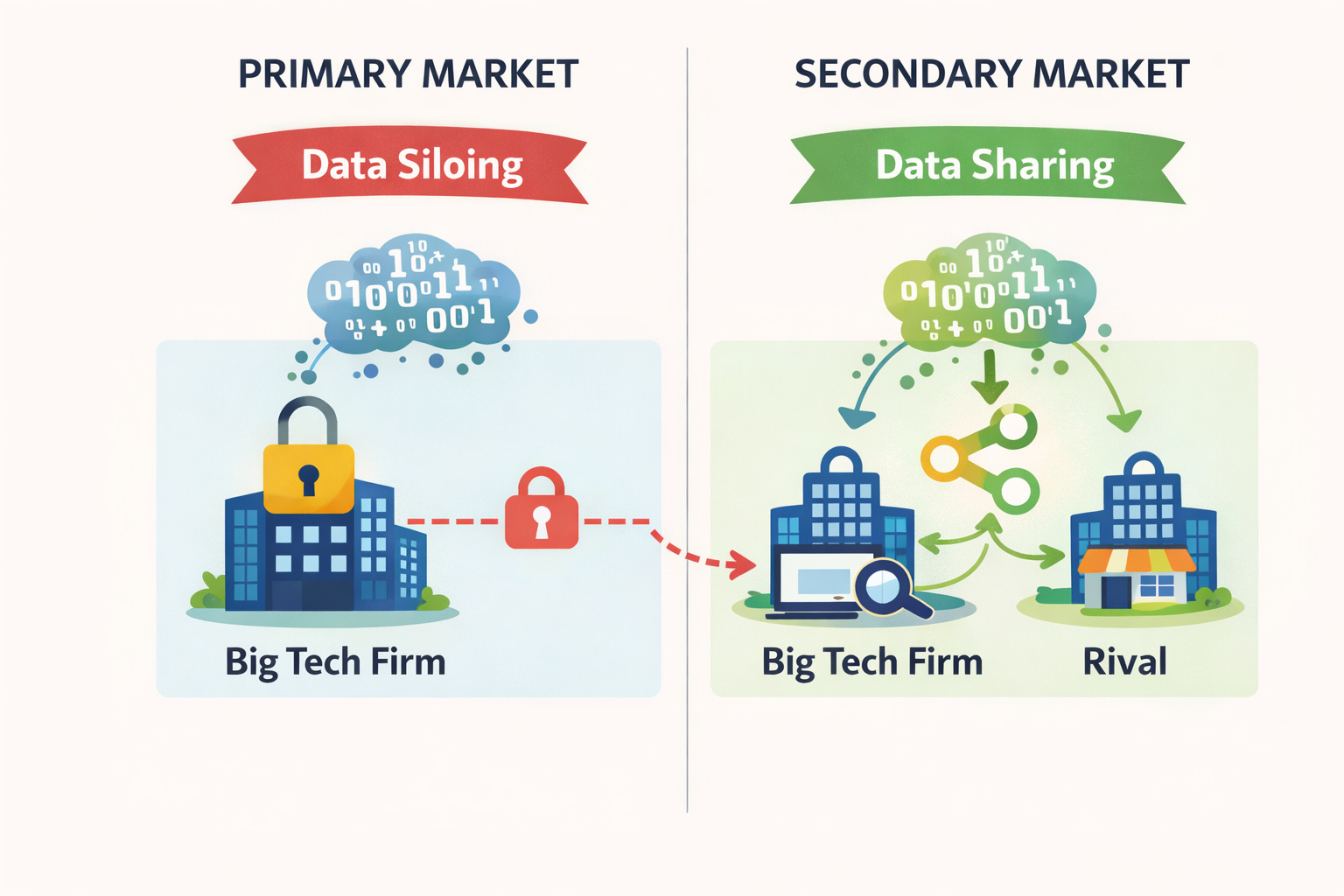
To level this data advantage of big-tech platforms, two regulatory tools have been proposed: data siloing and data sharing. Data siloing restricts platforms from using data collected in one market to improve the provision of service in another market. Instead, data sharing allows such cross-use of data but requires the dominant platform to share data (or insights derived from it) with competitors without access to such data. In the EU’s landmark regulation on digital platforms, the Digital Markets Act (DMA), both data sharing (for search engines) and data siloing (unless consumers consent to data combination) are required for very large online platforms, so-called gatekeepers.
In our work, we ask the following question: How do data siloing and data sharing provisions for dominant digital platforms affect innovation, competition, and welfare?
In our recent research, we study these questions using a formal game theoretic model. The model captures a setting that closely mirrors many real-world cases with a dominant platform that is active in a monopolized “primary” market (such as general search or an operating system) and competes with a rival in a “secondary” market (such as maps, or insurance). The key link between the two markets is that data from the primary market adds value in the secondary market. Specifically, higher usage in the monopolized primary market generates more data, which can be leveraged to improve services and innovation in the secondary (competitive) market.
How Data Regulation Affects Incumbents
Our first core result is that both data siloing and data sharing reduce the incumbent platform’s innovation incentives albeit for very different reasons.
Data siloing hinders data flows (and hence value flows) between markets. Under data siloing, the dominant platform is unable to leverage value from data generated in the primary market on to the secondary market. This makes investments in costly innovation in the primary market less valuable. In particular, increased investment to attract more consumers (and hence more data) does not offer an advantage in the secondary (competitive) market. This weakens the incentives to invest in innovation at the source of data generation.
By contrast, data sharing preserves the value from data flows but dissipates gains to consumers through increased competition in the secondary market. Specifically, when data must be shared with rivals, innovation by the dominant platform enhances value but some of that value now benefits competitors. This spillover reduces the private return to innovation for the incumbent which also dampens its innovation incentive.
While both tools dampen the incumbent’s innovation incentive, their welfare effects differ substantially.
Competition and Innovation by Rivals
Mandated data sharing has a direct positive effect on value generation, competition and innovation. In particular, it strengthens the (data deficient) competitors’ innovation incentives in the secondary market. Access to data generated by the big-tech platform allows the (data-deficient) rival to enhance its quality and compete on a more equal footing than without access to this data. This encourages the rivals of the big-tech platform to invest more in innovation. As competition intensifies, consumers benefit from better services and lower quality-adjusted prices which would be absent without mandated data sharing.
Data siloing, however, has a more ambiguous impact. It can help rivals only when the level of data shared is low. When data sharing is already substantial, stricter siloing reduces the total amount of data available in the ecosystem. Less data is generated in the primary market, and less can be shared. In this case, data siloing actually harms rivals’ innovation incentives and lowers overall market performance.
This interaction between data sharing and data siloing is critical to understand the data-value flows across markets. Specifically, increased mandated data siloing shrinks the very data pool that data sharing is meant to open up.
Welfare Effects: A Clear Ranking
From a welfare perspective, the contrast is stark.
Data siloing is unambiguously harmful. It reduces the amount of data that can be used in the secondary market. In addition to restricting data (and hence value) flows, innovation in the primary market and the secondary market is reduced. Due to lower innovation levels in the primary market, even less data is collected which subsequently weakens data-driven (value creation) efficiencies in the secondary market, lowering consumer surplus, and also decreasing total welfare. While it may appear to “level the playing field,” it does so by shrinking the amount of both the data generated and transferred.
Data sharing, in contrast, increases innovation (by the data-deficient rival) and thus also increases consumer surplus and total welfare in the secondary market, provided data cross-use is allowed. In the primary (monopolized) market, innovation incentives of the big-tech firm are reduced and thus also consumer surplus. Despite these reduced innovation incentives in the monopolized (primary) market, total welfare can increase. This happens when the gains from data are diffused resulting in higher innovation in the competitive market outweigh the welfare losses in the primary market. Consumers benefit from better services and lower effective prices, and total welfare increases.
The crucial caveat is that these gains from data sharing materialize only when the level of data siloing is limited. Combining strict data sharing with strict siloing undermines the benefits of both.
About the research: We study how data sharing and data siloing shape innovation, competition, and welfare in digital platform ecosystems. We employ a formal game-theoretic model featuring a dominant platform that operates in a monopolized primary market and competes in a secondary market linked through data flows. In such a market context, we analyze how data siloing or data sharing affects incentives and outcomes. We find that both data siloing and data sharing reduce the dominant platform’s innovation incentives, but through different mechanisms: siloing cuts off cross-market data value, while data sharing diffuses innovation gains to rivals. Their welfare effects diverge sharply. Data sharing increases the (data-deficient) rival’s innovation, and hence consumer surplus in the competitive market. In some cases, it can even increase total welfare (across the two markets) despite reduced innovation incentives in the monopolized market. Data siloing, by contrast, reduces data generation, weakens innovation across markets, and lowers overall welfare. Importantly, combining strict data siloing with data sharing commitments undermines the benefits of both, suggesting that regulatory frameworks prioritizing data sharing over data siloing are more likely to promote innovation, competition, and consumer welfare.
Implications for Regulation
These findings have direct implications for current regulatory approaches, especially in Europe. The DMA simultaneously mandates data sharing and imposes strong restrictions on data cross-use within platform ecosystems. Our analysis suggests that this combination risks being internally inconsistent and can even be detrimental to its initial purpose.
If the goal is to promote innovation, competition, and consumer welfare, the focus should be on data sharing rather than data siloing. Allowing dominant platforms to leverage data across markets, while ensuring that competitors can access those data, preserves efficiencies and fosters competition. Preventing cross-use altogether, by contrast, shuts down value creation (and diffusion) in the name of fairness.
Furthermore, the DMA currently demands data sharing only from online search engines. Our findings suggest that data sharing obligations are beneficial also in other primary markets, and thus support a widening of the data sharing obligation also to other platform services covered by the DMA, such as operating systems or social networking services.
More broadly, our results highlight a general lesson for digital regulation: policies that appear to level the playing field by restricting cross-market value flows of dominant firms may backfire if they undermine the mechanisms that generate value in platform ecosystems. Smart regulation should aim to open access without shutting down data-driven value creation.
In short, when it comes to regulating how big-tech platforms use data, sharing beats siloing.
This blog is based on research published in MIS Quarterly and is included in the Platform Papers references dashboard:
Krämer, J., & Shekhar, S. (2025). Regulating digital platform ecosystems through data sharing and data siloing: Consequences for innovation and welfare. MIS Quarterly, 49(1), 123-154.
Platform Updates
Microsoft and Apple hike hardware prices amid AI chip crisis (1) (2) (3) (📑): Microsoft increases Xbox prices globally while Apple substantially raises Mac and iPad costs, citing severe AI-driven memory chip shortages. These synchronized markups may expose the fragility of proprietary hardware moats, showing how surging supply-side costs could threaten the ecosystem’s scale.
Microsoft weighs Xbox spinoff and studio closures to cut costs (1) (2) (📑): Microsoft is reportedly considering divesting its gaming division and shutting down key first-party studios. This drastic restructuring signals a strategic pivot away from costly hardware moats and exclusive IP production toward cross-platform software multi-homing over console lock-in.
EU hits AWS and Azure with gatekeeper status (📑): The European Commission has provisionally designated Amazon and Microsoft’s cloud services as gatekeepers under the Digital Markets Act. By targeting high egress fees and structural lock-in, regulators aim to mandate interoperability at the infrastructure layer, making multi-homing across rival services viable.
UK tribunal sets 2028 trial for £3.5bn Amazon Buy Box lawsuit (📑): The Competition Appeal Tribunal scheduled a class action trial over allegations that Amazon self-preferences its own retail and fulfillment operations. Claimants argue that Amazon may exploit its dual role as a platform operator by weaponizing the algorithmic Buy Box to enforce third-party vendor lock-in.
EU hits Meta with interim measures over WhatsApp AI (📑): The European Commission ordered Meta to restore free API access to rival AI assistants on WhatsApp. By blocking Meta’s exclusive AI integration, regulators are mandating interoperability to prevent long-term platform lock-in over Europe’s critical AI distribution gateway.
‘China’s Instagram’ targets $70 billion valuation in Hong Kong IPO (📑): Xiaohongshu is preparing a massive public offering after reaching 400M monthly active users. By seamlessly integrating e-commerce into user-generated content, the company has built a highly lucrative multi-sided ecosystem that leverages powerful cross-side network effects between creators and shoppers.
Rockstar drops physical retail for $80 digital-only GTA 6 (📑): Grand Theft Auto 6 will launch strictly as a $79.99 digital download, offering a week-long preload to prevent storefront crashes. By bypassing physical discs entirely, Rockstar cements strict digital platform lock-in, while capturing maximum margins and setting a new premium pricing ceiling.
Platform Papers is published, curated and maintained by Joost Rietveld.